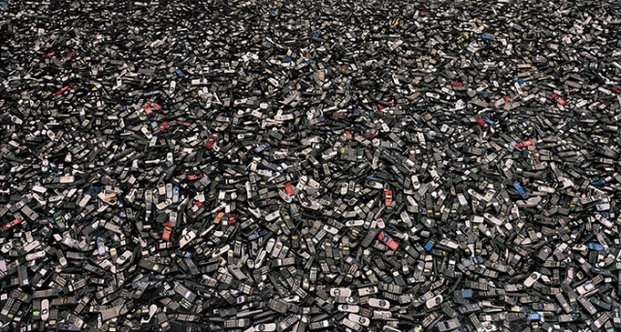
Besides all the toxic compounds of arsenic, lead, cadmium, mercury, beryllium, and copper that reside in your cell phone, there are also polybrominated biphenyls used as flame retardants on everything from wires to the plastic covers. We have a nice toxic brew in our hands and pockets all day - incinerate it, or let it become landfill leachate, and we release a cacophony of carcinogenic compounds into the environment. The price for innovation is paid at both ends - one miner death per week occurred in 2011 in the tin mines of Indonesia, extracting the ore for our gadgets (deaths which do not include long-term health effects of such mining). Apple's iPhone 5 generated 62,000 pounds of plastic waste in the first weekend alone as it changed, ironically, to a smaller SIM card. It would be interesting to assess what goes into and out of the life of one phone, to understand the social and environmental footprint...
Yesterday Google gave a well-deserved shout-out to Niels Bohr, the Danish physicist who developed the atomic model we still rely on to teach high school students the structure of the atom. Heck, I still rely on it myself to understand movement of electrons from orbit to orbit, emitting photons (or absorbing energy) in the process. A well-deserved honor, and a greatly timed coincidence: my students should be studying the evolution of atomic models as I sit here typing. - Link
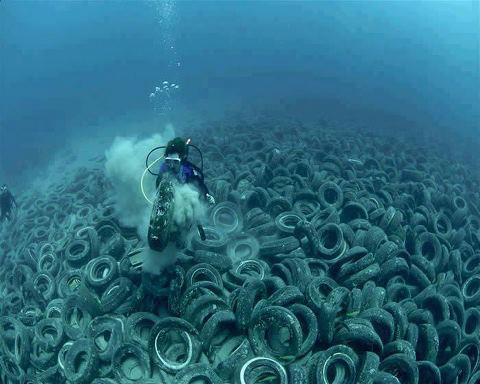
Those of you who know my colleague Rob Greenberg also know his passion for the earth. He recently linked to this image of the Osborne Reef Project, an attempt in the 1970s to find a use for used tires, combined with a desire to improve underwater habitats for fish populations. Storms and strong currents, however, have different motivations, and the tires have subsequently been shifted and moved to the point where they threaten existing natural reefs. The problem became compounded by the logistics of removing the tires.Artificial reefs are not always well planned. Attempts in New Zealand and England to "improve" habitats or bring in tourism have met the full strength of Mother Nature, which doesn't always agree with an engineer's intentions. If you're looking for a research project, read about the Osborne Reef Project here. What makes an artificial reef successful? What makes it an epic FAIL? - LINK
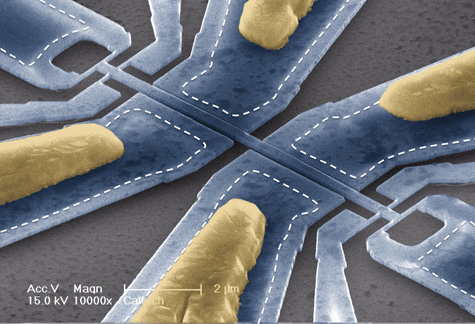
How cool is this? Instead of using mass spectrometry to measure the mass of large numbers of ionized molecules, scientists at Caltech have invented a device (shown above under a scanning electron microscope) that can measure the mass of ONE MOLECULE. Directly. The "nanoelectromechanical system resonator" is only 2 microns in length, and uses vibrational frequencies to identify the mass of a molecule that lands on it. - LINK
Randall Munroe of xkcd fame has outdone himself with his new "What if?" segment. I love that he uses math to actually calculate what we all (well, at least all us science nerds) are thinking. In this particular one, he postulates what a mole of the little furry animals would look like. It gets gloriously "gruesome." - LINK On another note, what if I actually am able to keep up with this blog thing throughout the year?
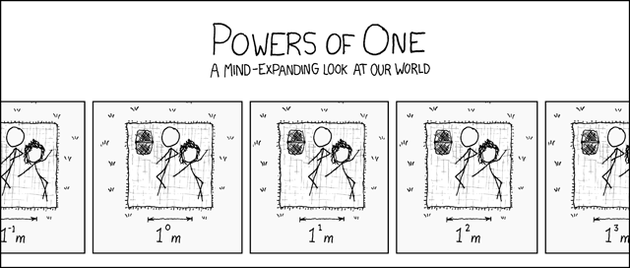
Since we're studying measurement in chemistry, I always show my students this old, award-winning film by Charles and Ray Eames called Powers of 10. Although it's dated, the video provides a great look at size and perspective. I particularly enjoy the alternation of matter and empty space, the notion that this alternation exists at both the macroscopic and microscopic levels.
Others have attempted to detail the power of perspective (like this one); it's amazing to me how well the Eames piece holds up.
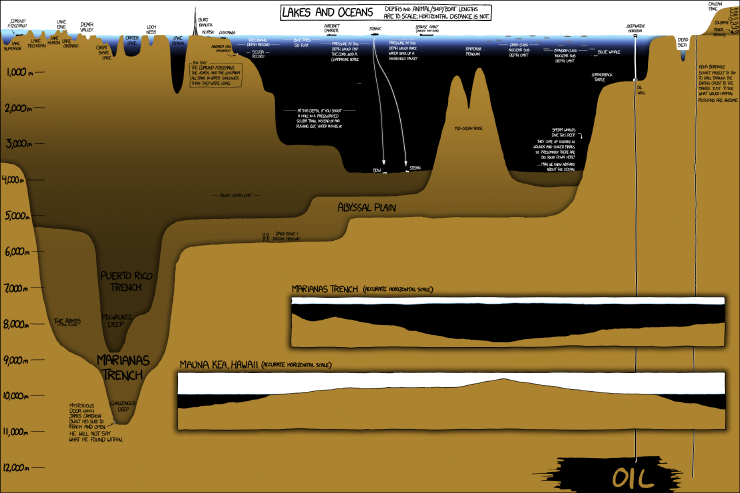
I especially like the xkcd take on it:
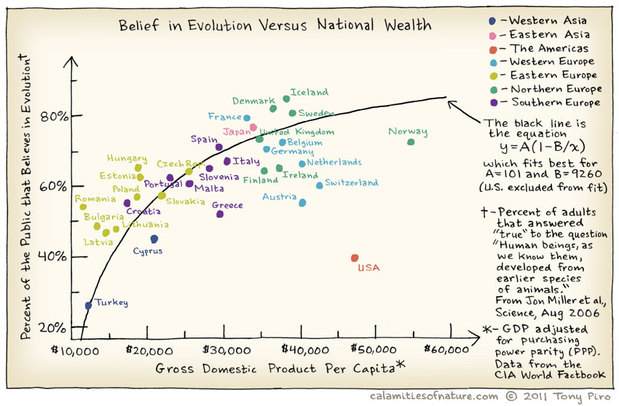
So, the correlation between wealth and education makes sense - the wealthier the nation, the more educated (presumably), therefore the more likely to believe in evolution. So why is the USA such an outlier? (*smacks forehead on table repeatedly*) - LINK
An array of detectors, part of the USArray/EarthScope Facility, picked up the microscopic movement of the earth in the wake of the August 23, 2011, Mineral, Virginia quake. Though I didn't notice the 5.9 quake, detectors as far as California and Canada measured displacement down to microns. Check out the ripples the Array picked up and where they concentrated. Why does movement continue in the New Madrid area after much of the movement has abated? Or for that matter, why are the detectors so dense throughout the plains?
..And for fun, check out this animated map of twitter reports as the earthquake occurred.
National Geographic's Cynthia Gorney has an article on the drastic drop in Brazil's fertility rate and what has contributed to it. The piece, called "Brazil's Girl Power," looks at a sharp drop in the number of children being born to each woman, a number that has plummeted over a mere two generations. "What took 120 years in England took 40 years here..something happened." - LINK
Saturday Morning Breakfast Cereal brings up an interesting point - there are lots of parasites that alter the behavior of their hosts, in many cases making their hosts more prone to predation, which ensures the parasite a new host. The Toxoplasma gondii protozoa is a brain parasite that likes to be in the gut of cats. So what happens when it gets eaten by a rat? It moves into the rat's brain, then "erases" the rat's fear of cats. Once the rat is no longer afraid of cats (though still afraid of everything else), it won't run away when a cat attacks it and eats it. Thereby eating the Toxo parasite. Thereby putting the parasite right where it wants to be: in the cat's intestines.
Funny thing is, the Toxo parasite has also infected a certain percentage of human brains (and hides pretty well). Infection varies by country - France and Germany, for example, have a high rate of infection while South Korea has a very low rate of infection.
What is to stop these parasites from changing human brains like they do to rats? Do they perhaps make people more prone to loving the primary host, the cat? Do they turn people into crazy cat ladies? If one parasite can do this, what other parasites are in our bodies altering our behavior? And finally, if they vary by country, are they to some extent influential on the culture of a people?
|